

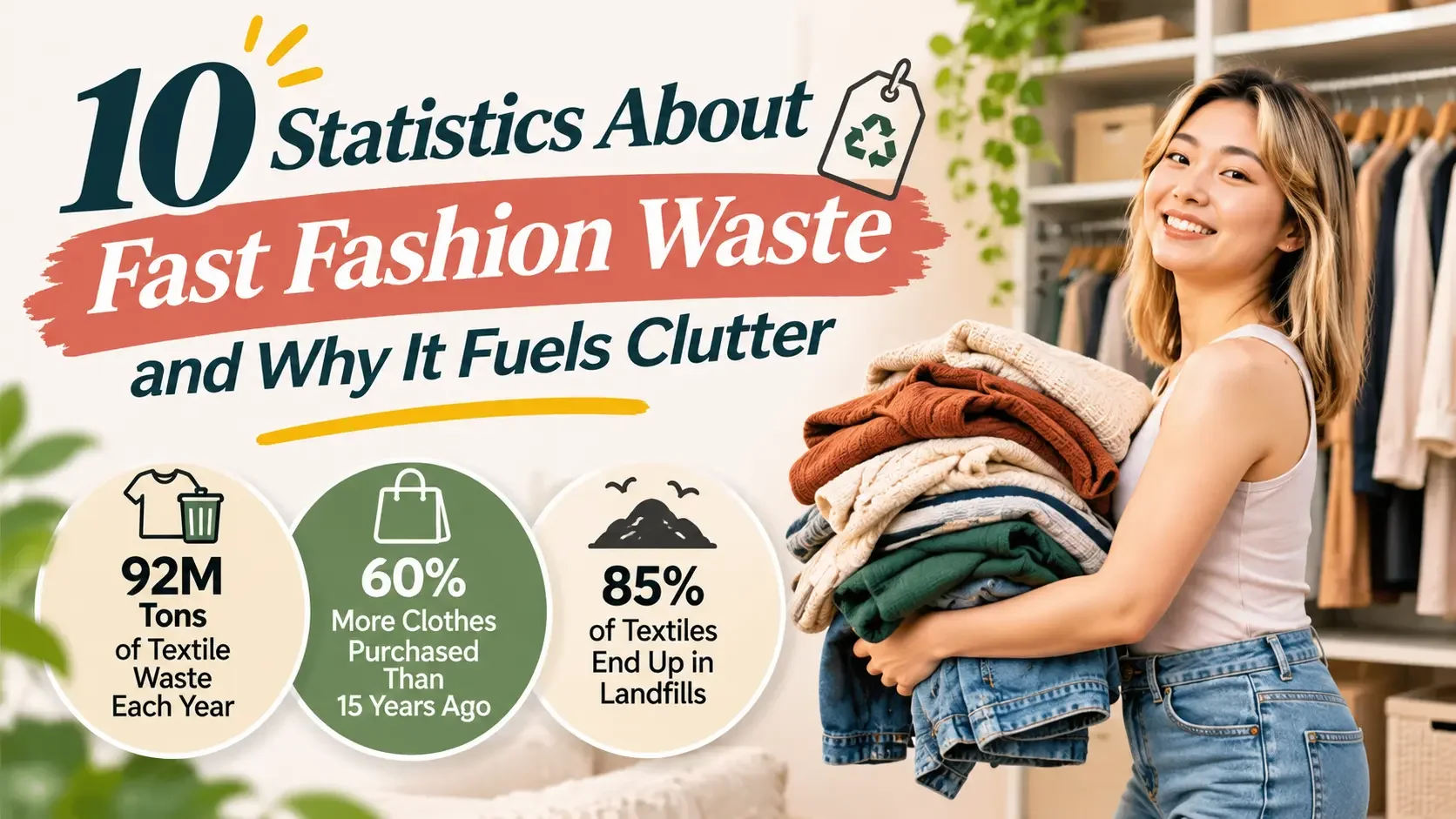
The environmental impact of fast fashion waste is significant, but its consequences extend beyond landfills and pollution. Frequent clothing purchases also contribute to overcrowded closets, overflowing storage spaces, and the growing number of garments many households struggle to organize.
At The Uncluttered Life, we encourage people to live with less unnecessary clutter. That does not mean giving up shopping or replacing every inexpensive garment with something more expensive. It means understanding how purchasing habits contribute to accumulation and recognizing that decluttering is most effective when we avoid immediately refilling the space we have cleared.
The relationship between fast fashion and home organization begins with how much clothing enters our homes, how long we use it, and what happens when we no longer want it. Our article on decluttering one category at a time explains how reviewing clothing together can help identify unnecessary purchases and forgotten belongings.
The following ten statistics illustrate why fast fashion waste matters and how thoughtful consumption can support both environmental responsibility and a more manageable wardrobe.
Fast Fashion Waste by the Numbers
1. Approximately 92 million metric tonnes of textile waste are generated worldwide each year.
According to the United Nations Environment Programme (UNEP), approximately 92 million metric tonnes of textile waste are generated globally each year. UNEP compares the amount of clothing incinerated or discarded in landfills to a garbage truck full of clothing every second. This figure includes textile waste beyond fast fashion clothing alone, but it illustrates the scale of the industry's waste problem.
2. The textile industry accounts for an estimated 2% to 8% of global greenhouse gas emissions.
The United Nations Environment Programme estimates that the textile industry contributes approximately 2% to 8% of global greenhouse gas emissions. Fiber production, manufacturing, dyeing, transportation, and other activities all contribute to the industry's environmental footprint. Reducing unnecessary clothing purchases and extending garment use are ways consumers can participate in efforts to limit waste and resource consumption.
3. The United States generated approximately 17 million tons of textile waste in 2018.
According to the U.S. Environmental Protection Agency, Americans generated approximately 17 million U.S. tons of textile waste in 2018, the latest year in the agency's published material-specific municipal waste series. This category includes clothing and other textile products. The figure demonstrates how discarded textiles contribute to the nation's overall waste stream.
4. Approximately 11.3 million tons of U.S. textile waste went to landfills in 2018.
The EPA also estimated that approximately 11.3 million U.S. tons of textiles were landfilled in 2018. Although some textiles were recycled or processed through other waste management methods, landfilling accounted for a substantial share of discarded materials. Donating usable clothing, repairing garments, and choosing appropriate textile recycling programs may help extend the usefulness of existing items, although not every donated textile is ultimately reused.
5. Clothing was worn 36% fewer times on average in 2015 than in 2000.
The Ellen MacArthur Foundation's A New Textiles Economy report estimated that global clothing utilization, measured by the average number of times a garment is worn before it stops being used, declined by approximately 36% between 2000 and 2015. This historical finding illustrates how clothing consumption patterns shifted toward shorter periods of use. It does not mean that every garment is worn only seven to ten times, since individual clothing habits and garment lifespans vary considerably.
6. More than $500 billion in clothing value was estimated to be lost annually through underuse and insufficient recycling.
The Ellen MacArthur Foundation's 2017 report estimated that more than $500 billion in value was lost globally each year because clothing was underutilized and materials were not sufficiently recycled. This is an industry-wide estimate of lost economic value, not money consumers could necessarily recover through resale. It highlights how frequently resources are invested in garments that receive relatively little use before leaving circulation.
7. Textiles are estimated to account for approximately 9% of microplastic pollution reaching the oceans.
According to UNEP, the fashion and textiles sector is responsible for an estimated 9% of microplastic pollution reaching the oceans annually. Synthetic fibers such as polyester and nylon can release tiny plastic particles during manufacturing, washing, and other stages of their life cycle. These particles contribute to pollution that can persist in aquatic environments.
8. Only about 8% of textile fibers produced in 2023 came from recycled sources.
UNEP reported that approximately 8% of textile fibers produced in 2023 came from recycled sources. This reflects the industry's continued dependence on newly produced materials, including fossil-based synthetic fibers. Importantly, recycled fiber does not necessarily originate from discarded clothing; some recycled polyester, for example, comes from plastic bottles rather than old garments. Improving textile-to-textile recycling remains an important challenge.
9. European Union countries generated approximately 16 kilograms of textile waste per person in 2022.
The European Environment Agency estimated that European Union countries generated approximately 6.94 million metric tonnes of textile waste in 2022, equivalent to about 16 kilograms per person. The same research found that average consumption of clothing, footwear, and household textiles reached approximately 19 kilograms per person. These figures highlight the relationship between high-volume textile consumption and the waste that follows.
10. Global fiber production reached a record 139 million metric tonnes in 2025.
According to Textile Exchange's 2026 Materials Market Report, global fiber production increased from approximately 132 million metric tonnes in 2024 to 139 million metric tonnes in 2025. This total covers fibers used in clothing as well as other textile and industrial applications, so it should not be interpreted as clothing production alone. Nevertheless, it illustrates the continued growth in demand for textile materials and the importance of addressing production, consumption, and waste throughout the supply chain.
What Fast Fashion Waste Has to Do With Decluttering
The connection between fast fashion waste and clutter becomes especially clear when you look inside an overcrowded closet. Frequent clothing purchases, rapidly changing trends, and inexpensive garments can make it easy to accumulate more than you realistically need or wear. Over time, closets fill with forgotten pieces, duplicate items, and clothing that no longer fits your lifestyle. This accumulation reflects broader consumer habits, but understanding those patterns can help you make more intentional decisions.
Decluttering your wardrobe provides an opportunity to evaluate what you actually own and how often you use it. Sorting clothing by category makes it easier to identify unworn items, recognize purchasing patterns, and determine which pieces deserve space in your closet. At The Uncluttered Life, we encourage clients to begin with the belongings they already have rather than purchasing additional storage products. Our article on decluttering one category at a time offers practical guidance for making these decisions without becoming overwhelmed.
Reducing clothing clutter does not mean giving up personal style or purchasing only expensive garments. It means choosing clothing that fits comfortably, suits your daily activities, and is likely to be worn regularly. Caring for existing garments, repairing items when practical, considering secondhand options, and avoiding unnecessary impulse purchases can help reduce waste while maintaining a wardrobe you enjoy.
Before replacing the clothing you have decluttered, consider why those items accumulated in the first place. Were they purchased because of temporary trends, attractive discounts, or the belief that you needed more options? Recognizing these habits can help prevent your closet from filling again. The most sustainable approach to decluttering combines thoughtful decisions about what you keep with greater awareness of what you bring into your home. Small steps, done consistently, create big results.
Source for additional environmental background: Earth.org.